Diary written in 1977 while living in Sri Lanka, accounting for events and thoughts. At the end of most daily accounts will be ‘notes’ that were written after returning to the United States. These notes are reflections of the original events. The original diary entries were written in a way that would make it easy to remember the day’s events and protect privacy if the diary were confiscated.
Forward
Our daily lives are filled with lessons learned. Naturally, we don’t realize what we have learned until the learning experience is over. We need experiences to guide us through life. There was a time before social networks. There was no internet, and adventures were sometimes risky. Your imagination was a door, and it took courage to venture into the unknown.
If you thought you were a special person with knowledge and status in your comfortable culture. It only takes a cross-cultural experience to realize that you are just one individual in the world. Relationships and ideas make us what we are, and how you deal with these experiences and thoughts will guide you in the right direction. Is that what you are looking for?
The world of cultural understanding is constantly changing. It is up to individuals to understand cultural values to make the world a better place. When we know ourselves, we become a world citizen.
World of Questions
- Prelude: What does my background have to do with this?
- The First Step: How in the world did I get to Sri Lanka?
- The Orientation: Why did we need an indoctrination?
- Our Families: Who are the people we live with?
- Binational Tour One: Why do we need to see the country?
- Back Home With Families: Do we need to take a break?
- Binational Tour Two: Do we need to revisit the country?
- Time to Leave Home: Why am I getting tired of these people?
- On My Own: Why do I need to be single again?
- My Personal Adventure: Why I need to take a trip on my own?
- Preparing to Go Home to the USA: Do I need to get back home?
Prelude
This story has its roots in the late 1950s. Living in southern Virginia during the times of racial segregation. There were not many views of the outside world. My parents bought a set of encyclopedias for my sister and me. I spent many nights going through these books, and the one that fascinated me was the book with maps of various countries around the world, as well as pictures and descriptions of the people who lived there.
One evening, I was watching television with my father when the picture blurred, and a man’s voice came over the television, talking to someone. It was not part of the program that we were watching that night. My father said it was a neighbor talking on his radio. I did not know what he was talking about, but I knew the neighbor.
The next day, I told my best friend who lived directly across from the neighbor. We sneaked over to the house that evening and listened outside his basement window to find out what was happening. We heard him talking to someone and then someone else responding in a weird voice. Somehow, the neighbor saw us outside his window and asked us what we were doing. We told him we heard him on the television and came to see what was going on. The neighbor invited us into his basement.
When we went in, I saw something I had never seen before. There were all kinds of radios, including ham radios. He said that with the radios he could talk to people all over the world. We were fascinated by this, and we would often go by his house, sit outside his window, and listen to him talk to many people. I decided I had to have one of these radios, and with my allowance, I saved up and bought myself a shortwave radio.
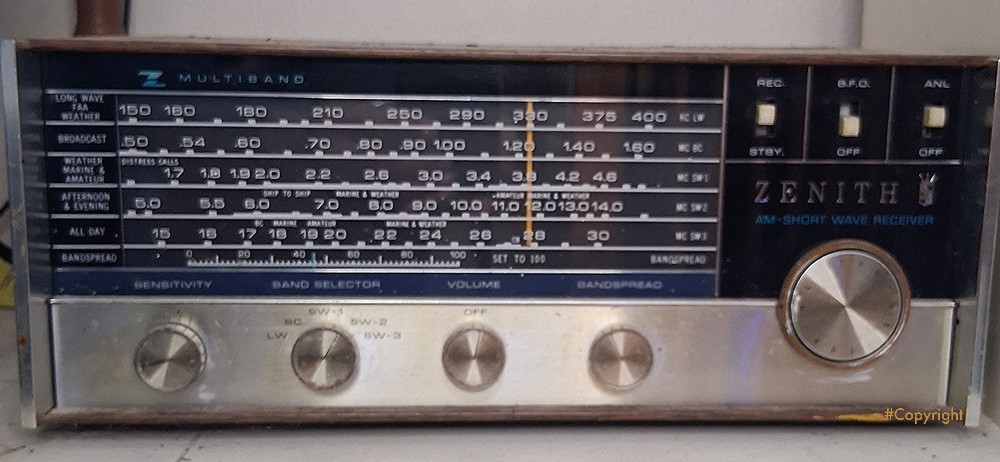
My late nights were spent listening to international radio stations. I had a large world map on my wall where I would mark the countries I had listened to, such as China, Russia, Switzerland, Venezuela, Cuba, and many others. I learned how to write to the radio stations in these countries, and they would send me a QSL card proving that I had received their station. I became so good at tuning into stations that I moved to military radio stations. I would send letters asking them who they were and for other information. During this time, the Cold War and the Cuban Missile Crisis were in full swing.
I watched the events about Cuba on television, but as a grade school child, it didn’t mean much to me. One day, a white man came to our home. Living in a segregated community, a visit from an unknown white person carried much suspicion. My father promptly answered the door, and there was a car with the US Government on the side. I then learned that this white man was a military investigator who wanted to know who was writing to military radio stations asking questions. The investigator easily found our home because I gave them my address. The investigator was shocked to find out that I was a black child just interested in the world and what I had heard on the radio. He laughed and went on his way without any questions.
I went to a segregated black school until the tenth grade. While at the black school, I performed well academically. It was the times during the civil rights movement. There were many black leaders at that time, and I followed most of the controversial ones. Some events in my black community at that time influenced my thoughts toward a more militant stance than a pacifist one. For the last three years of high school, I attended an integrated school, and I did not do well academically but excelled in sports. In my senior year, I became concerned about my future after high school.
It was the era of the Vietnam War, and many of the men in my community went off to war, never to return. The soldiers who returned from the war had another sense of black identity that fascinated me. I had entertained the thought of joining the military until I listened to the voices of black soldiers during this time. When I turned eighteen, I received my draft card. I had to decide: Vietnam, Canada, or college? I chose to go to college.
My first year of college was spent at Shaw University, a historically black college. I had the idea of becoming an architect, but I became more wondrous after taking other courses. I wrote a paper in a psychology class that impressed the teacher. She told me I had a talent for psychology and that I should pursue it as a major. The only problem was that the university did not offer that major, so I would need to go to another university. After searching and other events, I attended Marshal University, where I received a degree. It was at this university that another event happened that pointed me to Sri Lanka. After college, I worked for a while in my hometown before deciding to pursue graduate school.
The First Step
To start a new adventure requires a first step, and my first step came from a decision made out of disgust. It is said that major lifetime decisions are made out of disgust with some event. I became disgusted one day while taking a graduate sociology class at the College of William and Mary, where I was the only African American in the class. One day, the class discussion concerned people in third-world countries and their conditions and political goals. This was an open discussion, and I was the only one who defended the situations and goals these people found themselves in.
I considered the conditions and political goals of African Americans to be similar to those of third-world countries. The teacher and fellow students ridiculed me. I stood my ground but was met with a barrage of “how do you know, have you ever been there? I was unable to answer this question, and that day I decided that I would never be caught in that situation again. It was that day that I decided to quit my theoretical graduate studies and travel to gain experience in another culture to see whether my opinions were correct. This was ironic because I felt I was already living in another culture at the college.
It was mystical how I ended up in Sri Lanka. The day after that disgusting class, I was walking through the classroom building, and my mind was still on the discussions and my frustration. I went out a different way from the building, walking down a different hallway and passing a bulletin board. There was a poster on the board advertising academic credit for living in a different culture. This was peculiar because I had seen this poster somewhere before, but had not paid it much attention. I stood there reading the advertisement and decided to apply to this program called The Experiment in International Living.
After applying to the program and being accepted without any problems, it was time to choose a country to live and study in. I selected Nepal as my country, but later received a letter from the school stating that all students had been chosen for the program. I selected India as the country, and I started planning a trip there. I got a passport and sent it to the Indian Embassy to get a visa for the journey. It was weeks later that, after not hearing from the Embassy, I contacted them, and they notified me that they had not received my passport. I later learned that my passport had been stolen, and now I had to apply for a replacement. One night, I was looking at information on other countries and came across another program in Sri Lanka, which offered a longer stay than in India. For some reason, I changed my mind, and the next day I called the program to switch to Sri Lanka.
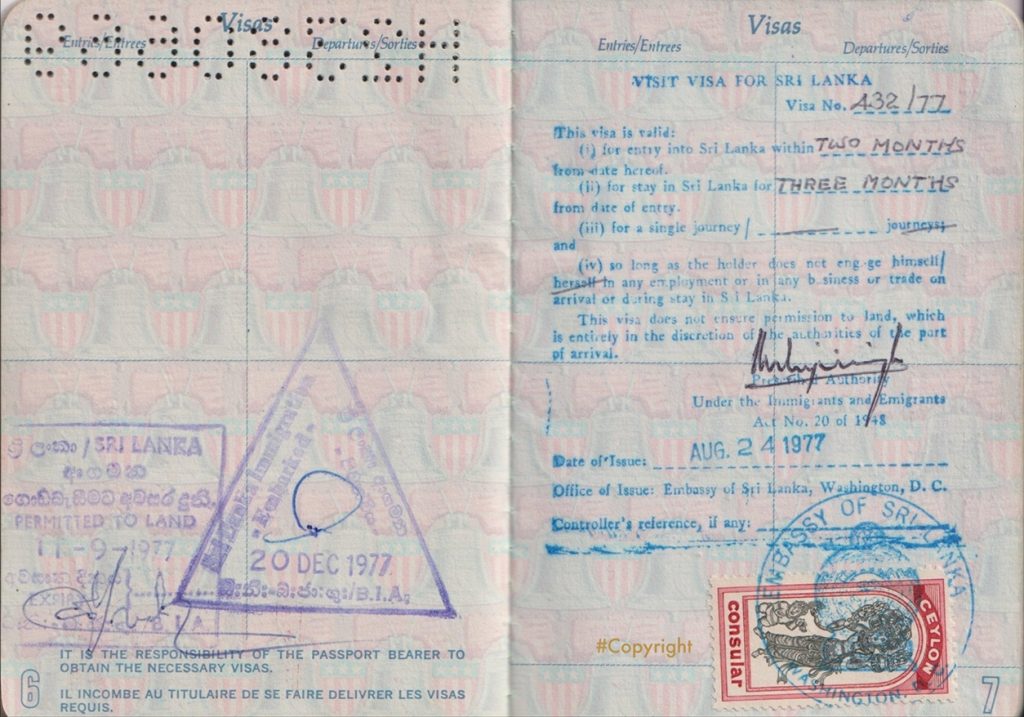
When I was researching the country, for some reason, the descriptions of the religious culture, Buddhism, seemed familiar. It was not until I was going through a box of books from my college days at Marshall University that I discovered why Sri Lanka was so familiar. There was a philosophy professor I studied under who was writing a book on the history of philosophy. He worked late at night, had an open-door policy for his students, and invited them to stop by any time. It was not surprising that he would have 10 students in his office at 2:00 AM, discussing the problems of life. On one of these occasions that I stopped by his office, he gave me a book on Buddhist ethics. This was such a fascinating book that I kept it, read it often, and never returned it to him. It was not until I discovered the book some years later that I realized it was written in Ceylon, now known as Sri Lanka. This was a significant event because when the professor gave me this book, he said, “One day this may help you.”
Through minor events, significant decisions, and changes of mind, I found myself scheduled to travel halfway around the world. Sri Lanka only became a reality through my desire for a cross-cultural experience. My parents were questionable about my decision, and my friends looked on in awe. My decision was based on a strong need to experience another culture. These events made me take the first step, leading to an experience that could never be truly expressed in words.